LIttle Red Riding Hood

In my paper presented at the ID-Net Conference on Play this past July I wrote about Kieran Egan‘s theory of imagination and how young children think about the world differently based on their imaginative schemas.  Specifically I focused on the mythic and imaginative forms of thinking.  I chose the fairy tale of Little Red Riding Hood to explore the ways in which even very young children abstract big ideas from their stories.  Simply looking at images of Red Riding Hood can open up fascinating doors for reflection.  For example, take these two illustrations/art works:
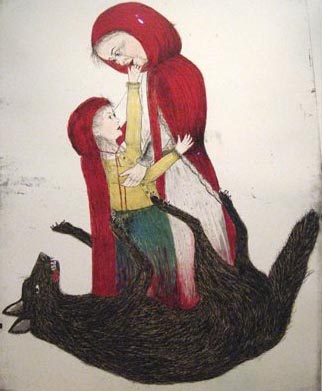
Kiki Smith's work

Kiki Smith’s work

Walter Crane (1875) illustration for the story

Walter Crane (1875) illustration for the story


Each image offers up a world.  Kiki Smith depicts the grandmother and Little Red Riding Hood as emerging from the body of the wolf.  Women have often been associated with animals, the material and sensuous (wild, non-rational)  nature.  The red of the cape emerges out of the blood of the wolf: death, life–the bleeding that women experience and that terrifies the male psyche.  From Crane’s traditional portrait of the girl meeting the wolf  we recognize the wolf as male- as threatening to the girl.  He wears the veneer of civilization in his clothing but the tail, sharp teeth, and lolling tongue betray his lustful and destructive nature.  As Egan guides us we recognize the big binary ideas of male/female, human/animal, death/life, safety/danger.  Young children grasp the import of these stories as far broader and deeper than simply amusing tales of long ago and far away.

For one more fascinating rethinking of the Little Red Riding Hood story, check out this video.  I thank the Blogger on Dog Art for finding this creative revisiting.

http://vimeo.com/3514904

Philosophy and women

women-phil

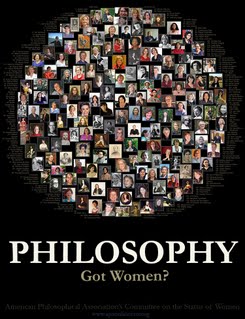
I found this image when I googled ‘women philosophers’ and was struck by the piercing eyes and absent mouth

Well this news item showed up this weekend in the New York Times about the philosopher Colin McGinn who has set off a debate about sexism in the profession.  There is a news flash, right?  However, in all fairness, my personal experience cannot testify to this wide-spread sexism.  I entered graduate school a long time ago; so you might think that it would have been even worse then.  Plus I went to a Jesuit institutions where all the faculty but one were men and most of my fellow graduate students were men as well.  I think that I can recall one other woman but she left soon to study religion in Hawaii.  Whether I was just incredibly naive and oblivious or whether I represent the women who did not experience sexual harassment, I am not entirely sure.  The Times article referenced this blog by  philosopher Jennifer Saul whose work I have used in my own classes and I have to say it is a damning collection of reports of sexual harassment, bias against women and just overall dismissal of women in philosophy.  Even my own anecdotal observations at the APA (American Philosophical Association) meetings noted the decrease in the number of women in the profession as represented by attendees.

There are indeed women, fine thinkers, in philosophy if one looks.

There are indeed women, fine thinkers, in philosophy if one looks.

In my recollections of my own graduate school experiences, I did note that the men in my  department never had any doubts whatsoever about their skills, intellectual potential and future in the discipline.  I was riddled with self doubt but frankly, based on what I still claim to be a realistic appraisal of my own limited talents.  And yet my professors seemed to accept me on the basis of what I could do, not type me by gender.  Maybe sexism has worsened since the 70s-80s?  Or do many of the current issues arise in top drawer programs which are so caught up with their own self-importance that they implode at the suggestion that anyone really deserves them, much less women?  Something to think about.

Real Estate Ethics?

So, what are the ethical guidelines for real estate agents in selling a house to someone who will then flip it or reconstruct it for sale via the same agent? Let’s say that you list your old house with an agent who assures you it is worth, say $2 million–due to its location. The market is slow and you really need to sell it. The agent knows this. Almost a year goes by with little action. Then along comes a builder who sees the property as valuable but the house as not. Your agent has worked with him before and pretty soon he is pressuring you to sell to the builder. He even suggests letting him demolish the house before closing so that the builder can get going on his project! The agent warns you that you have to decide right away or you will lose this fabulous sale! The fact that the offer is way, way below asking price (which you have already adjusted downward once) is brushed off as basically your last chance to sell. The market is now dreadful and will not recover for years, you are assured.

Luckily your lawyer laughs over the demolition request but the pressure to sell is strong and your own need is well-known to everyone. You regretfully sell. –At the hugely discounted price. The new owner/builder quickly tears down the old house and builds a McMansion

sign

in its place, absorbing the half-acre plot in its pretentiousness. Lo and behold: the real estate for sale sign goes up…with your agent’s name as the selling agent.

Now, surely agents are allowed to sell a house multiple times, but there is something in the sequencing and the entire process that does not sit quite right. At what point did the agent switch from being your advocate to advocating for his buyer who has most likely promised him the handling of the sale of the new construction? Can an agent advocate fairly for both the buyer and seller when the payoff is so tempting on the buyer’s end?

I am not entirely sure that any impropriety occurred and yet, I still wonder…